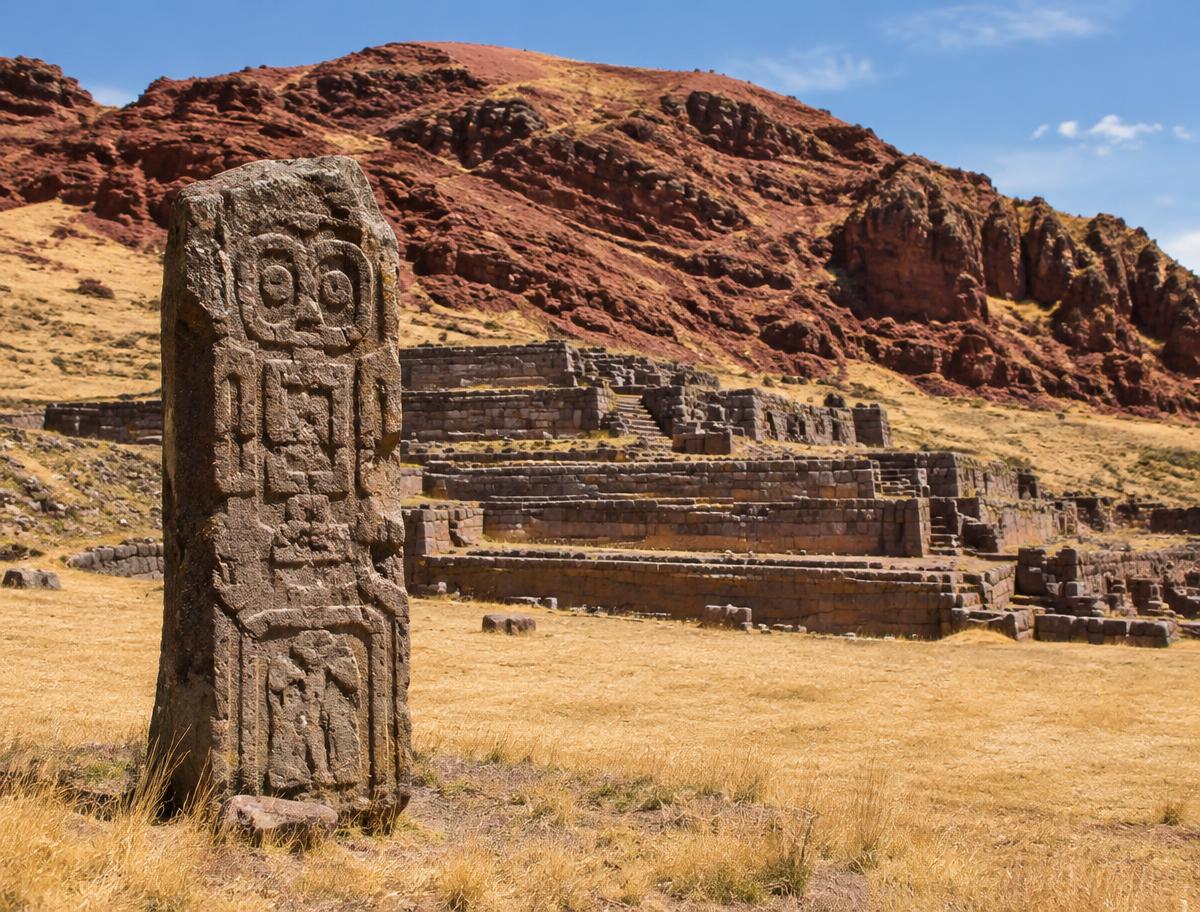
Destination 03 · Lampa, Puno region
Pukará — The Ancient Ceremonial Center of Lake Titicaca
Carved stelae and terraced platforms from one of the earliest complex societies of the Titicaca basin.
DraftNote: this is Pukará in the Puno region, in the northern Titicaca basin. It is not Puka Pukara, the small Inca site near Cusco.
Where it is
PracticalThe archaeological site lies beside the present-day town of Pucará, in the province of Lampa, Puno region, on the high plain north of Lake Titicaca. The town sits on the road between Juliaca and Cusco, at close to 3,900 metres, beneath a striking red sandstone ridge.
What researchers know
Archaeological evidencePukará gives its name to the Pukara culture, which flourished in the northern Titicaca basin in the centuries before and around the turn of the first millennium CE. It was one of the region's earliest large ceremonial centres and predates the rise of Tiwanaku on the southern side of the lake.
The core of the site is a monumental complex of stepped terraces built against the hillside, crowned by sunken rectangular courts surrounded by small rooms. Excavations have documented carved stone stelae and sculptures, as well as distinctive polychrome pottery.
The stone sculpture
Pukara carving includes standing figures, slab stelae with geometric and animal motifs, and images often interpreted as felines, fish and serpents. Many pieces can be seen at the small lithic museum in the town. Scholars see the Pukara style as an important influence on later artistic traditions of the Titicaca region.
Open questions
How Pukará was organised politically, how far its influence extended, and why it declined are still the subject of research. Much of the wider site lies beneath fields and the modern town.
The living town: toritos de Pucará
Pucará is also known for its ceramics, above all the toritos — glazed clay bulls that are placed on rooftops in many parts of southern Peru. Their associations with protection, prosperity and fertility are widely told. We are documenting workshops in the area and will only feature makers who choose to take part.
A wider Titicaca journey
Pukará fits naturally into a slower route around the lake: the markets of Juliaca and Puno, the burial towers of Sillustani, and the shoreline communities of the lake itself.
Preparing to visit
PracticalThe altiplano is cold, bright and high. Bring sun protection and warm layers. Practical details on this page are an early draft. Check opening hours, entry tickets, road conditions and local guidance before you travel.